
A CNC machining quote is only as accurate as the information behind it. When procurement teams receive quotes that don't reflect actual production cost, or when parts arrive that don't match expectations, the root cause is almost always traceable to an incomplete or ambiguous RFQ. The supplier priced what they understood — which wasn't what the buyer intended.
These are the seven RFQ mistakes that most consistently produce inaccurate quotes, rejected parts, and surprised buyers — along with the straightforward fixes that eliminate them.

A useful RFQ gives the supplier enough information to price the intended part rather than a set of assumptions.
The Cost of a Bad RFQ
An inaccurate quote doesn't just create a budget problem. When a supplier under-quotes because the RFQ omitted critical requirements, the production order may reveal those requirements mid-run — leading to change orders, delays, and the awkward conversation about who absorbs the cost difference. When a supplier over-quotes because they had to assume worst-case for everything underspecified, you may be paying a significant premium over what your parts actually cost to produce.
The investment required to submit a complete RFQ is measured in minutes. The cost of fixing the problems that incomplete RFQs create is measured in days, dollars, and damaged supplier relationships
The 7 Most Costly RFQ Mistakes
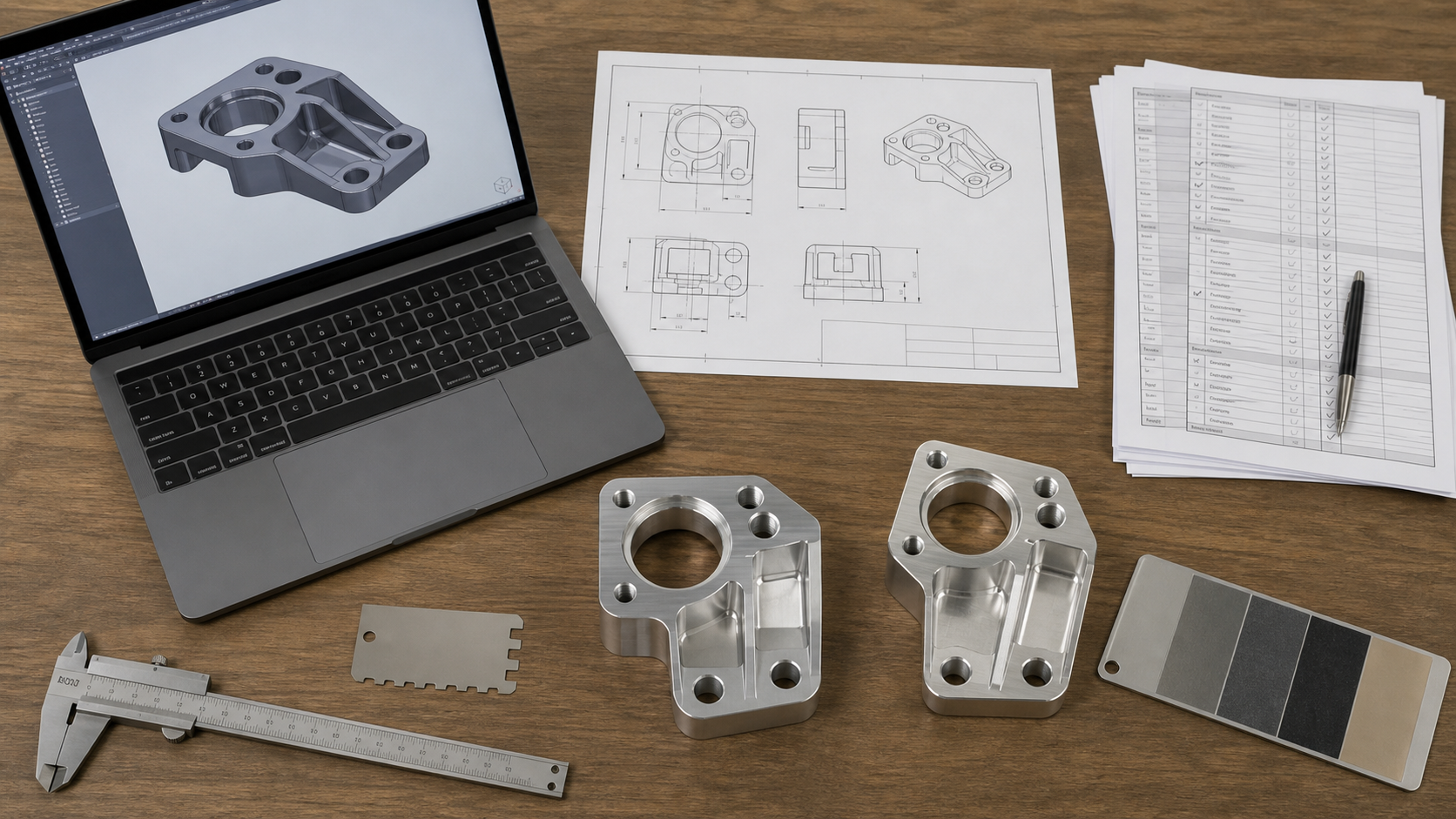
Send the 3D model, controlled 2D drawing, material, quantity, finish and documentation requirements together.
Mistake 1: Underspecified Material
"Aluminum," "stainless steel," or "plastic" are categories, not specifications. Each category contains dozens of grades with significantly different mechanical properties, machinability, cost, and regulatory compliance. A supplier who receives an underspecified material callout must make an assumption — and that assumption may not match your functional requirements, your regulatory needs, or your cost expectations.
The fix is simple: always specify the exact grade. 6061-T6, 316L, Ti-6Al-4V Grade 5, PEEK unfilled. If you have flexibility — if 6061 or 6082 would both work — state that explicitly. Documented material flexibility can save cost and lead time; undocumented flexibility creates risk.
Mistake 2: No General Tolerance Block
Every CNC machining drawing has dimensions that aren't individually toleranced — they're intended to be controlled by the drawing's general tolerance. Without a general tolerance block, the supplier has no defined default and must either ask (delaying the quote) or assume (creating a risk). Common supplier defaults range from ±0.1mm to ±0.5mm depending on their market and customer base — a significant spread that can determine whether your parts fit.
The fix: include a general tolerance block in every drawing title block. For most commercial CNC parts, ±0.1mm linear and ±0.5° angular covers non-critical features without imposing unnecessary cost. For precision applications, ±0.05mm general with tight callouts on functional features is appropriate.
Mistake 3: Omitting Surface Finish Requirements
If your drawing has no surface finish callout, the supplier will machine to their default — typically Ra 3.2μm for milling, Ra 1.6μm for turning. This is adequate for most non-functional surfaces. It's inadequate for sealing faces, bearing surfaces, wear interfaces, or any surface where roughness directly affects performance.
The fix: add Ra callouts to every surface where finish matters. Sealing faces typically need Ra 0.8–1.6μm. Bearing fits need Ra 0.4–0.8μm. Cosmetic surfaces need whatever finish your visual standard requires. If a surface has no functional finish requirement, leave it uncalled and let the supplier default — that's appropriate. Just make sure the functional surfaces are explicitly called out.
Mistake 4: Quantity Without Volume Context
Quoting "10 pieces" gives a supplier everything they need to price this order. It gives them nothing to optimize tooling, fixturing, or scheduling for your future orders. A supplier who knows that 10 pieces now will become 200 pieces per month in three months may invest in dedicated fixturing that reduces your unit cost on the production run — but only if you tell them.
The fix: include a volume forecast in your RFQ when you have one. Even rough estimates — "prototype quantity now, expect 50–200 per month in production" — enable the supplier to make better process decisions that benefit both parties.
Mistake 5: Impossible Deadlines
A buyer who needs parts in 5 days for a job that requires 8 days of machining, treatment, and shipping creates a problem that has no good solution. The supplier either declines (unhelpful), commits and misses (damaging), or cuts corners to hit the date (dangerous). None of these outcomes serves the buyer's actual interest.
The fix: share your real deadline and ask for an honest assessment of whether it's achievable. If it isn't, ask what lead time is achievable and what options exist to compress it — rush machining, air freight, expedited surface treatment. A transparent conversation about timeline is more productive than an impossible deadline that everyone pretends is real.
Mistake 6: 3D Model Without a 2D Drawing
3D models are essential for CNC programming and DFM review. They are not engineering drawings. A 3D model doesn't specify tolerances, surface finish, material grade, or general tolerance. A supplier quoting from a 3D model alone must interpret all of these — and their interpretation may not match yours.
The fix: always provide a 2D drawing with your 3D model. The drawing is the governing document — it defines requirements. The model aids visualization and programming. When both are present, there's no ambiguity about which controls the part.
Mistake 7: Undeclared Special Requirements
Certificates of conformance, material certifications, first article inspection reports, RoHS declarations, specific packaging requirements, country of origin documentation — these are requirements that may be obvious to you but are invisible to a supplier who hasn't been told about them. A supplier who ships without these documents isn't negligent; they just didn't know you needed them.
The fix: include a special requirements section in your RFQ template. List every documentation, certification, packaging, and compliance requirement that applies to this order. Requirements declared at RFQ are priced in. Requirements discovered at delivery are expensive to retrofit.