If you've sourced CNC machined parts internationally, you've likely encountered drawings or quotes that reference standards you didn't recognize. ISO 2768. ASME Y14.5. H7/g6. RC3. These aren't interchangeable — they come from different engineering drawing traditions, use different notation systems, and interpret tolerances differently in ways that can cause real problems if a supplier and customer are working from different assumptions.
This guide explains the key differences between ISO and ASME tolerance standards, when each applies, and what you need to specify clearly when working across both systems.
The Two Major Tolerance Frameworks
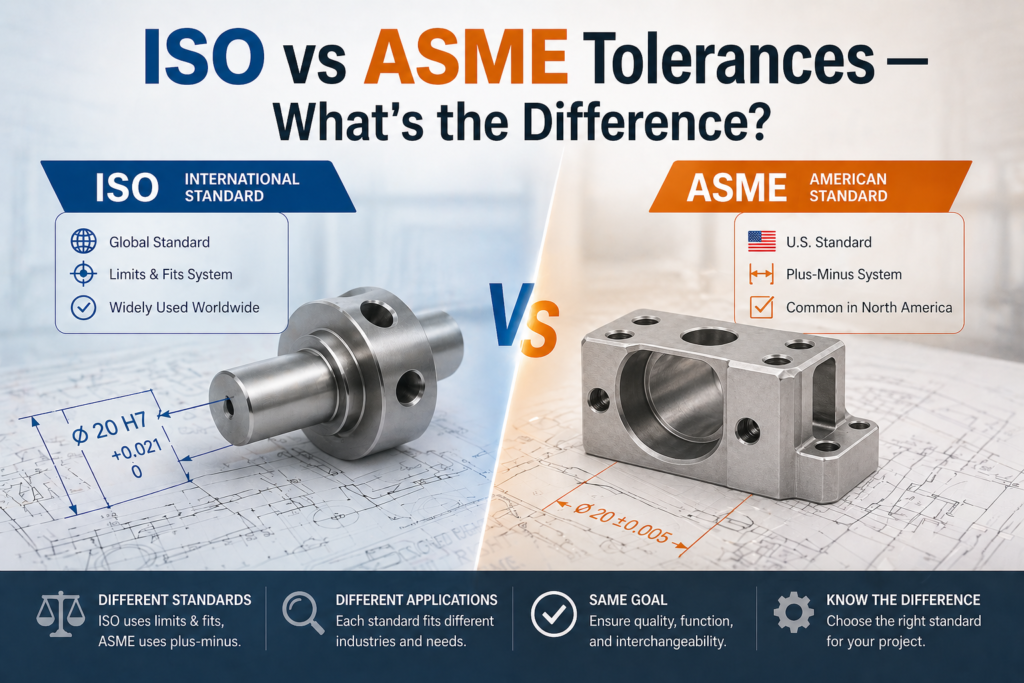
Most CNC machined parts in global manufacturing are dimensioned and toleranced according to one of two major standards systems: ISO (International Organization for Standardization), which dominates in Europe, Asia, and most of the world outside North America, and ASME (American Society of Mechanical Engineers), which is standard in the United States and heavily used in US aerospace and defense.
The differences between these systems go beyond notation. They reflect different engineering traditions, different ways of expressing fit requirements, and different approaches to geometric tolerancing.
ISO 2768: General Tolerances for Machined Parts
ISO 2768 defines general tolerances for linear dimensions, angular dimensions, and geometric characteristics (form and position) that aren't individually toleranced on a drawing. It uses tolerance class designations — f (fine), m (medium), c (coarse), v (very coarse) — to set the default allowable variation for untoleranced dimensions.
When a drawing references ISO 2768-m, it means: any dimension without an explicit tolerance should be interpreted using the medium class limits defined in the standard. For a 50mm linear dimension under ISO 2768-m, the general tolerance is ±0.1mm. Under ISO 2768-f (fine), it tightens to ±0.05mm.
The practical implication: when submitting a drawing to an international supplier, specifying your ISO 2768 class in the title block eliminates ambiguity about default tolerances. Without it, the supplier will apply their own default, which may not match your intent.
ISO 286: The Fit System
ISO 286 defines a system of limits and fits for mating cylindrical features — bores and shafts. The system uses a letter to designate the fundamental deviation (position of the tolerance zone relative to the nominal size) and a number to designate the tolerance grade (size of the tolerance zone).
In the designation H7/g6, H7 describes the bore: H means the lower deviation is zero (the bore starts at nominal), and 7 is the IT grade (tolerance width). g6 describes the shaft: g indicates a small negative deviation (the shaft is undersized relative to nominal), and 6 is the IT grade. Together, H7/g6 defines a clearance fit — the shaft will always be smaller than the bore, ensuring free rotation or sliding.
Common ISO fit combinations for CNC machined parts include H7/h6 (close sliding fit, minimal clearance), H7/k6 (transition fit, could be slight clearance or interference), H7/p6 (interference fit, press fit), and H6/k5 (precision transition fit for bearing seats).
ASME Y14.5: The GD&T Standard
ASME Y14.5 is not a tolerance magnitude standard like ISO 2768 — it's a language for expressing geometric requirements on engineering drawings. It defines the symbols, rules, and interpretation of geometric dimensioning and tolerancing (GD&T): form controls (flatness, roundness, cylindricity, straightness), orientation controls (perpendicularity, parallelism, angularity), location controls (true position, concentricity, symmetry), and runout controls (circular runout, total runout).
The most recent version is ASME Y14.5-2018. Key rules in ASME Y14.5 that differ from ISO 1101 (the ISO GD&T equivalent) include the Rule #1 envelope principle (a feature of size must not violate a perfect-form boundary at maximum material condition), the interpretation of regardless of feature size (RFS) as the default for geometric tolerances, and specific rules around datum reference frame construction.
These differences matter when a drawing created to ASME Y14.5 is sent to a supplier who interprets it using ISO 1101 conventions. The same symbol can have different implications, and the same part could be accepted or rejected differently depending on which standard the inspector is applying.
Practical Guidance: Avoiding Standard Mismatches
When working with international CNC suppliers, a few practices eliminate most tolerance standard confusion. Always specify the drawing standard explicitly in the title block — "Tolerances per ISO 2768-m" or "GD&T per ASME Y14.5-2018" leaves no room for assumption. For fits, use the ISO 286 letter-number designation rather than descriptive terms like "sliding fit" or "press fit", which are interpreted differently across industries.
If you're an American company sending drawings to an overseas supplier, confirm that they're familiar with ASME Y14.5 if your drawings use GD&T. Many international shops are more fluent in ISO 1101. Providing a brief note on critical GD&T callouts — "Position tolerance applies at RFS per ASME Y14.5" — prevents misinterpretation on the dimensions that matter most.
When in doubt, ask your supplier which standard they default to, and confirm that their measurement equipment and inspection procedures are calibrated to that standard. A mismatch between your drawing standard and your supplier's inspection practice is a quality risk that's entirely preventable.
→ Have a drawing with specific standard requirements? Share it with us — our engineers will confirm interpretation before we quote.