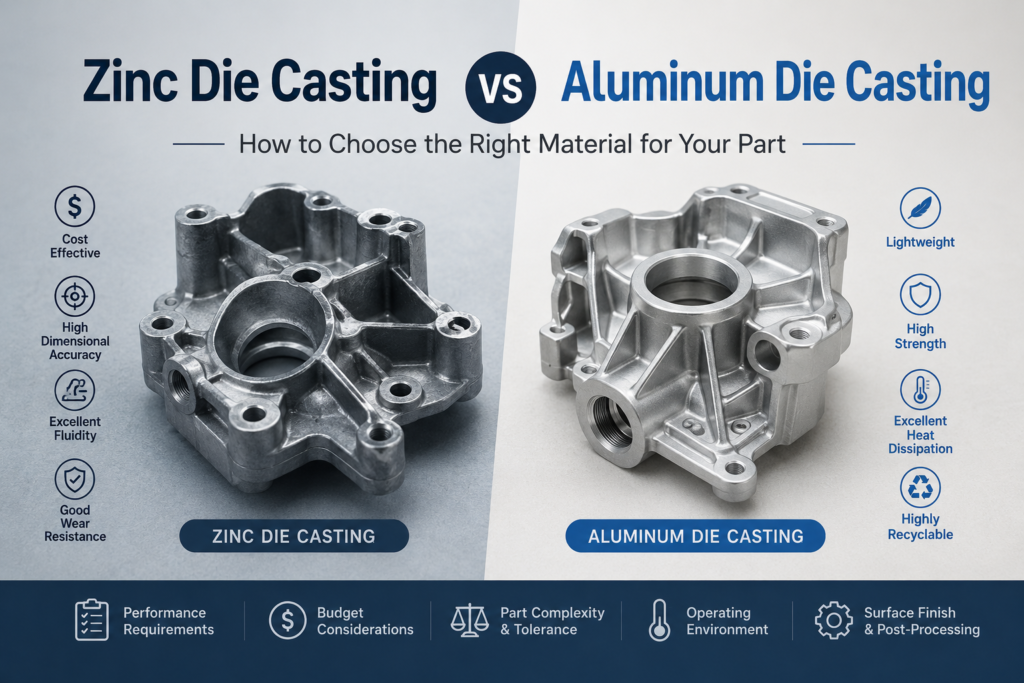
Zinc and aluminum are the two dominant materials in die casting — together they account for the vast majority of die cast parts produced globally. Both are versatile, both produce excellent as-cast surface finishes, and both support a wide range of post-processing options. But they have meaningfully different properties, process characteristics, and cost profiles that make one clearly better than the other for most applications.
This guide compares zinc and aluminum die casting across every dimension that matters for the design and procurement decision.
Side-by-Side Comparison
Understanding the Process Difference
Hot Chamber (Zinc)
Zinc die casting uses a hot chamber process — the injection system is submerged in the molten zinc bath. Because zinc melts at only ~420°C and doesn't aggressively attack steel, the plunger and cylinder can operate continuously immersed in the melt. This enables faster cycle times (10–30 seconds), lower injection pressures, and less die wear than cold chamber processes.
The hot chamber process is also more automated and requires less manual ladling between shots, which reduces labor cost and process variability. For high-volume small parts, hot chamber zinc die casting is one of the most cost-efficient manufacturing processes available.
Cold Chamber (Aluminum)
Aluminum requires a cold chamber process because its higher melting point and reactivity with iron would rapidly destroy a submerged injection system. Each shot requires the operator or automated system to ladle molten aluminum from the holding furnace into the shot sleeve before injection. This adds cycle time (30–120 seconds) and introduces more process variability than hot chamber, but it enables the higher injection pressures needed to fill larger, more complex aluminum parts.
When to Choose Zinc
Zinc die casting is the better choice when your part is small to medium in size (typically under 2kg), needs very fine detail or thin walls (below 1mm), requires excellent surface finish for decorative applications like plating or painting, needs tight dimensional tolerances with minimal post-machining, will be produced in high volume where fast cycle times reduce unit cost, and where weight is not a primary concern.
Classic zinc die casting applications include door hardware and lock mechanisms, electrical connectors and contact housings, automotive interior trim components, precision instrument housings, small gear and cam components, and decorative hardware across consumer and industrial products.
Zinc alloys — most commonly Zamak 3, Zamak 5, and ZA-8 — are easy to plate and paint, making them the first choice for parts where surface appearance matters. Zinc also has good self-lubricating properties and excellent impact resistance, which suits it to functional hardware applications.
When to Choose Aluminum
Aluminum die casting is the better choice when weight is a critical design driver — aluminum is roughly 60% lighter than zinc at equivalent volume. It handles higher operating temperatures (zinc softens above ~100°C; aluminum alloys retain strength to 150°C and beyond). It offers better structural performance for load-bearing applications. It's the right choice for larger parts that exceed what hot chamber tooling can practically accommodate, and for parts that will be anodized — anodizing is effective on aluminum but not applicable to zinc.
Aluminum die casting dominates in automotive structural and powertrain applications, electronics thermal management, industrial equipment housings, and any application where the part needs to be both lightweight and mechanically capable. EV battery enclosures, motor housings, power electronics brackets — these are all aluminum die casting applications where zinc simply can't match the performance requirements.
The Cost Reality
Material cost alone doesn't determine which option is more economical. Zinc alloy ingot typically costs more per kilogram than aluminum, but zinc parts are often heavier due to higher density. More importantly, tooling life is typically longer for zinc dies (lower temperature = less thermal fatigue), and cycle times are shorter, which drives down per-part cost at high volumes.
For small, complex, high-volume parts where zinc's process advantages are fully realized, zinc die casting often beats aluminum on total part cost despite higher material price. For larger, structurally demanding, weight-sensitive parts, aluminum wins on both performance and economy.
The honest answer is that for many parts, either material could work — and the cost difference between them is smaller than the cost of choosing the wrong one and having to retool. When in doubt, share your part requirements with your casting supplier and ask for a cost comparison on both options.
Can You Switch Materials After Tooling?
Switching from zinc to aluminum die casting (or vice versa) after tooling has been built is generally not feasible without new tooling. Hot chamber zinc dies and cold chamber aluminum dies use different machine configurations, different gating systems, and different cooling designs. The tooling is not interchangeable.
This makes material selection an early and consequential decision. Get it right before tooling is cut — which means understanding your volume, weight, temperature, dimensional accuracy, and surface finish requirements before committing to a casting material.