
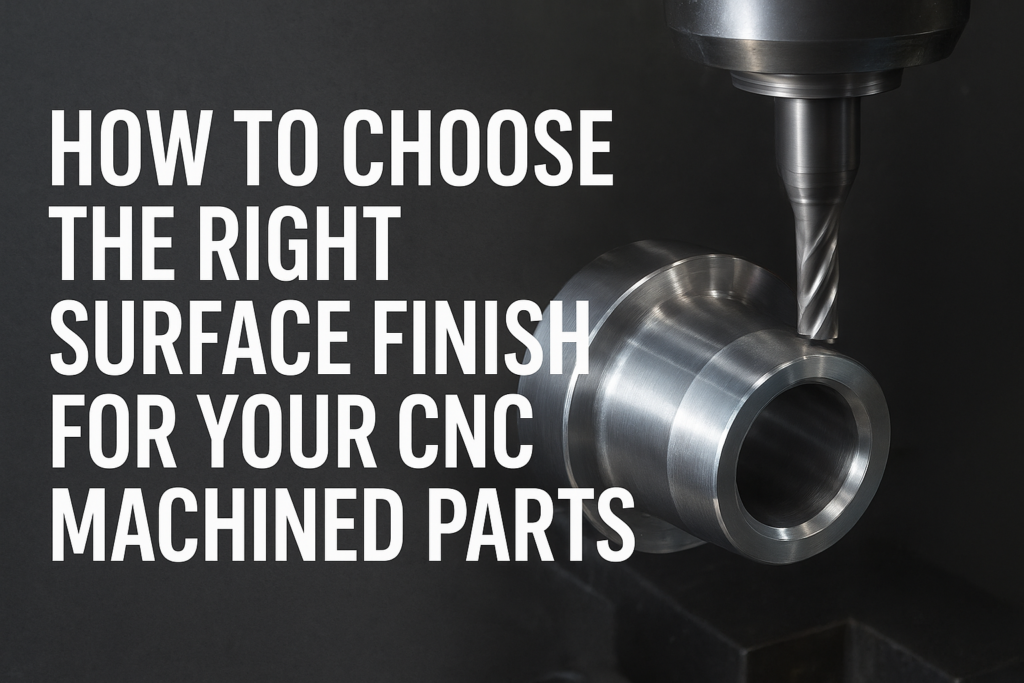
When designing a CNC-machined component, dimensional accuracy and material selection often get the most attention. However, one factor that significantly affects performance, durability, and appearance is often overlooked — surface finishing.
The right surface finish can transform a machined part by improving corrosion resistance, strengthening the surface, enhancing appearance, or preparing it for later assembly steps. In this article, we’ll explore how to select the most suitable finish based on your material, application, and performance requirements.
1. Why Surface Finishing Matters
A freshly machined part may look clean and precise, but its raw surface still carries tool marks, micro-burrs, and natural imperfections. Without proper finishing, the part may experience:
Faster corrosion
Poor wear resistance
Reduced aesthetic value
Difficulties with coating or assembly
Shortened service life
Surface finishing helps solve these issues and allows your part to meet higher functional standards.
2. Common Surface Finishes for CNC Machined Parts
Different materials require different finishing methods. Here are the most commonly used options in precision manufacturing:
Anodizing (Type II / Type III)
Ideal for aluminum parts, anodizing creates a protective oxide layer that enhances corrosion resistance and surface hardness.
Type II: Decorative, available in multiple colors
Type III: Hard anodizing for industrial wear resistance
Electroplating (Chrome, Nickel, Zinc)
Metallic coatings improve conductivity, corrosion resistance, and appearance.
Chrome: Bright and wear-resistant
Nickel: Good hardness and lubricity
Zinc: Excellent corrosion barrier
Powder Coating
A thick, durable coating available in various colors, ideal for cosmetic and protective applications.
Sandblasting
Produces a uniform matte texture, commonly used for aluminum parts to achieve a premium look.
Polishing
Removes scratches and tool marks, resulting in a mirror-like finish for decorative or functional purposes.
Passivation (Stainless Steel)
Lorem ipsum dolor sit amet, consectetur adipiscing elit. Ut elit tellus, luctus nec ullamcorper mattis, pulvinar dapibus leo.Chemically removes contamination from stainless steel surfaces, improving corrosion resistance without changing appearance.
3. How to Choose the Best Surface Finish
① Based on Material
Different materials react differently to finishing processes.
Aluminum: Anodizing, bead blasting, powder coating
Stainless Steel: Passivation, polishing
Steel: Electroplating, painting
Brass: Polishing, clear coating
② Based on Application
Consider the working environment and functional needs:
Outdoor parts → Corrosion-resistant finishes
Moving components → Low-friction coatings
Consumer products → Attractive cosmetic finishes
③ Based on Durability Requirements
High-wear environments benefit from:
Hard anodizing
Chrome plating
Heat treatments
④ Based on Aesthetic Requirements
If appearance is a priority:
Matte finish → Bead blasting
Glossy finish → Polishing
Colored finish → Anodizing or powder coating
4. Why T-one Is Your Trusted Surface Finishing Partner
At T-one, we not only specialize in high-precision CNC machining but also provide a comprehensive range of surface treatments to ensure the longevity and visual quality of every part. Our engineers evaluate each project to recommend the optimal finishing process, balancing performance, budget, and appearance.
Our capabilities include:
✔ Anodizing (Type II & III)
✔ Polishing & brushing
✔ Electroplating
✔ Powder coating
✔ Bead blasting
✔ Passivation
✔ Custom finishing upon request
Every finishing process follows strict quality control to ensure consistent results for every batch.
Surface finishing is not just a cosmetic detail — it’s an essential part of manufacturing that enhances durability, appearance, and functionality. Choosing the right finish ensures your CNC-machined components perform at their best in any environment.
For expert guidance and professional finishing services, T-one is ready to support your next project with precision and reliability.