
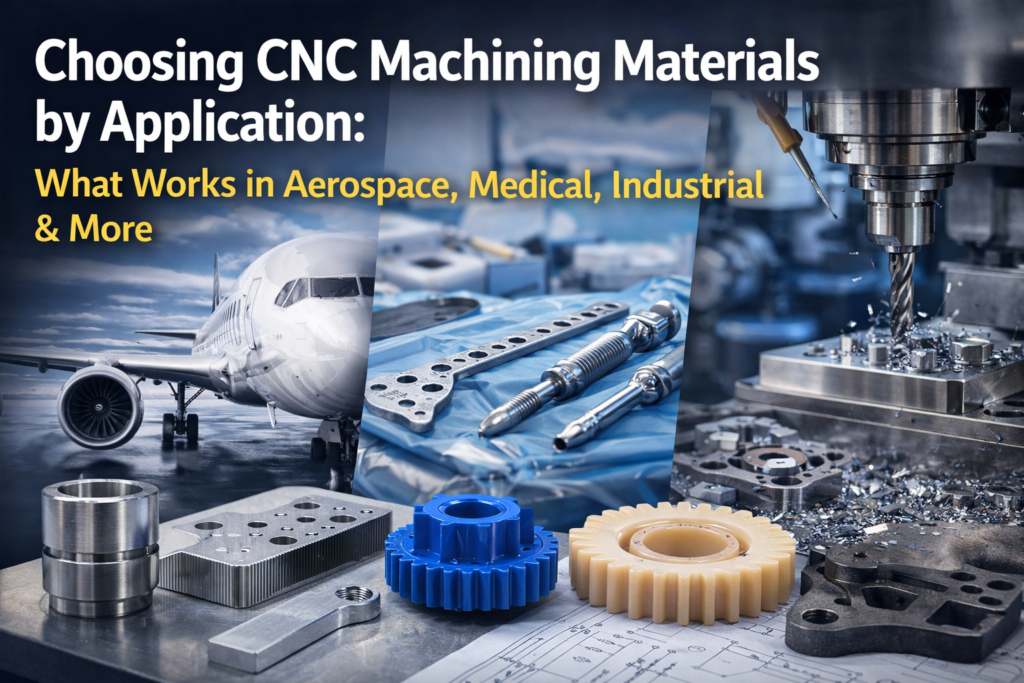
Most material selection guides start with the material and work toward the application. This one does the opposite — because that’s how engineers actually think when they sit down to spec a part. You know what it needs to do. The question is what it should be made of.
Here’s a practical breakdown of the best CNC machining materials for each major application category, drawing from the full range of metals and plastics we machine every day.
Full Material Capability Reference
We machine the following materials across all application categories:
Metal Materials
| Material | Grades Available | Best For |
|---|---|---|
Aluminum |
6061, 6063, 6082, 7075, 2024, 5052 |
Lightweight, corrosion-resistant, fast to machine. Best for housings, brackets, and prototypes. |
Stainless Steel |
303, 304, 316, 316L, 410, 416, 420, 17-4PH, 15-5PH |
Strong and corrosion-resistant. Covers medical, food-grade, marine, and high-strength applications. |
Steel |
1018, 1045, 1215, 4130, 4140, 4140PH, 4340 |
High strength and hardness. Preferred for gears, shafts, tooling, and load-bearing components. |
Brass |
C230, C260, C360, H62, H65, H90, HA177-2 |
Excellent machinability and finish. Standard choice for fittings, valves, and connectors. |
Copper |
C10100, C10200, C11000 |
Maximum electrical and thermal conductivity. Used in electronics and heat-management parts. |
Titanium |
Grade 5 (Ti-6Al-4V) |
High strength-to-weight ratio, biocompatible. Aerospace, medical implants, and motorsport applications. |
Plastic Materials
| Material | Ideal Applications |
|---|---|
ABS |
General-purpose prototype and functional part material. Easy to machine, good impact resistance. |
POM (Delrin / Acetal) |
Precision mechanical parts: gears, bushings, sliding components. Excellent dimensional stability. |
Nylon (PA6 / PA66) |
Self-lubricating and flexible. Used for fixtures, structural brackets, and mechanical housings. |
PEEK |
Top-tier heat and chemical resistance. FDA-compliant grades available for medical applications. |
PC (Polycarbonate) |
Impact-resistant and optically clear. Ideal for covers, lenses, and protective enclosures. |
PMMA (Acrylic) |
Optical clarity and smooth finish. Display panels, light guides, and cosmetic components. |
PP (Polypropylene) |
Lightweight and chemically resistant. Lab equipment, tanks, and industrial fluid components. |
PVC |
Good weather and chemical resistance. Fluid-handling fittings and industrial piping parts. |
PTFE (Teflon) |
Non-stick and chemically inert. Seals, liners, and electrical insulation components. |
HDPE / UHMW |
High wear resistance, low friction. Conveyor parts, wear strips, and sliding guides. |
Application-by-Application Material Guide
Aerospace & Defense Components
Aerospace machining demands a combination of high strength, low weight, and full material traceability. The standard material hierarchy runs: aluminum 7075-T6 for primary structural parts where weight is the dominant constraint; titanium Ti-6Al-4V when corrosion resistance and biocompatibility matter alongside strength; 4340 alloy steel and 17-4PH stainless for landing gear components, actuator bodies, and high-load brackets; and Inconel or other superalloys for engine-adjacent components that see sustained high temperatures.
For non-structural interior and bracket applications, 6061-T6 aluminum is often the cost-effective default. All aerospace orders we process include mill certifications and are available with first article inspection (FAI) documentation.
Medical Devices & Implants
Medical CNC machining has non-negotiable requirements: biocompatibility, corrosion resistance, and the ability to withstand repeated sterilization cycles. Titanium Grade 5 (Ti-6Al-4V ELI for implant-grade) is the first choice for implantable components — orthopedic devices, dental fixtures, surgical instruments. 316L stainless steel covers the majority of non-implantable surgical tools and medical hardware due to its excellent corrosion resistance and proven sterilization compatibility.
For non-metallic medical parts — endoscope components, housings, fluid-handling assemblies — PEEK is the go-to engineering plastic. It’s biocompatible, autoclave-sterilizable, and chemically inert across the full range of medical disinfectants. Delrin and Nylon cover lower-cost, non-sterile medical equipment housings and functional components.
Industrial Machinery & Automation
Industrial applications span the widest range of material requirements. For structural and load-bearing components — frames, brackets, mounting plates — 6061 aluminum covers most cases. When wear and fatigue resistance are needed, 4140 or 4340 steel steps in. Gears, drive shafts, and coupling components typically call for 1045 or 4140 steel with appropriate heat treatment.
On the plastic side, Delrin (POM) is the workhorse material for gears, bushings, cam followers, and any sliding component where low friction and dimensional stability matter. UHMW and HDPE cover high-wear linear guide applications. Nylon handles vibration-damping fixtures and cable management hardware.
Electronics & Semiconductor Equipment
Electronics applications split into two material needs: electrical conductivity and electrical insulation. For conductive components — bus bars, electrode contacts, heat spreaders — C10100 oxygen-free copper and C11000 electrolytic copper deliver maximum conductivity. For EMI shielding housings and chassis, aluminum 6061 anodized to specification is standard.
Insulating components use engineering plastics: PEEK for high-temperature board-level components, PC for enclosures and covers, and PTFE for anything that needs to be both insulating and chemically resistant. Acrylic (PMMA) covers optical windows and light-guide components in instrumentation.
Fluid Systems: Valves, Fittings & Manifolds
Material choice in fluid systems is driven by the medium being handled. For water, air, and mild chemicals: brass C360 is the dominant choice for its excellent machinability and reliable sealing surface finish. For aggressive chemicals and high-purity fluids: 316 or 316L stainless with electropolish finish, or PTFE and PP for the most aggressive environments. For hydraulic systems under pressure: 4140 steel or 17-4PH stainless, depending on corrosion exposure.
Prototypes & Product Development
Prototype material selection is often a balance between matching production material properties and managing cost. When the prototype needs to simulate the final production part precisely — testing structural integrity, fit, or stress response — machine it in the same alloy. When you’re validating geometry, ergonomics, or basic function, 6061 aluminum or ABS plastic gets you there faster and cheaper.
Our team regularly advises product development clients on the right prototype material for each validation phase. A part that’s going into fatigue testing needs a different material than one being used for a trade show demo — and we’ll tell you which is which.
Making the Right Call
The right material isn’t just the one that meets the mechanical spec — it’s the one that meets the mechanical spec at the right cost, lead time, and risk level for your project. That sometimes means specifying a slightly over-engineered material to reduce risk. Other times it means simplifying your alloy selection to consolidate your supply chain.
Our engineering team reviews every drawing before quoting and flags potential material concerns — grade substitutions that could improve performance, alloys that might be difficult to source on short lead time, or cases where a plastic could replace a metal at significant cost savings.
→ Send us your drawing or application brief. We’ll recommend the right material and get you a quote within 24 hours.