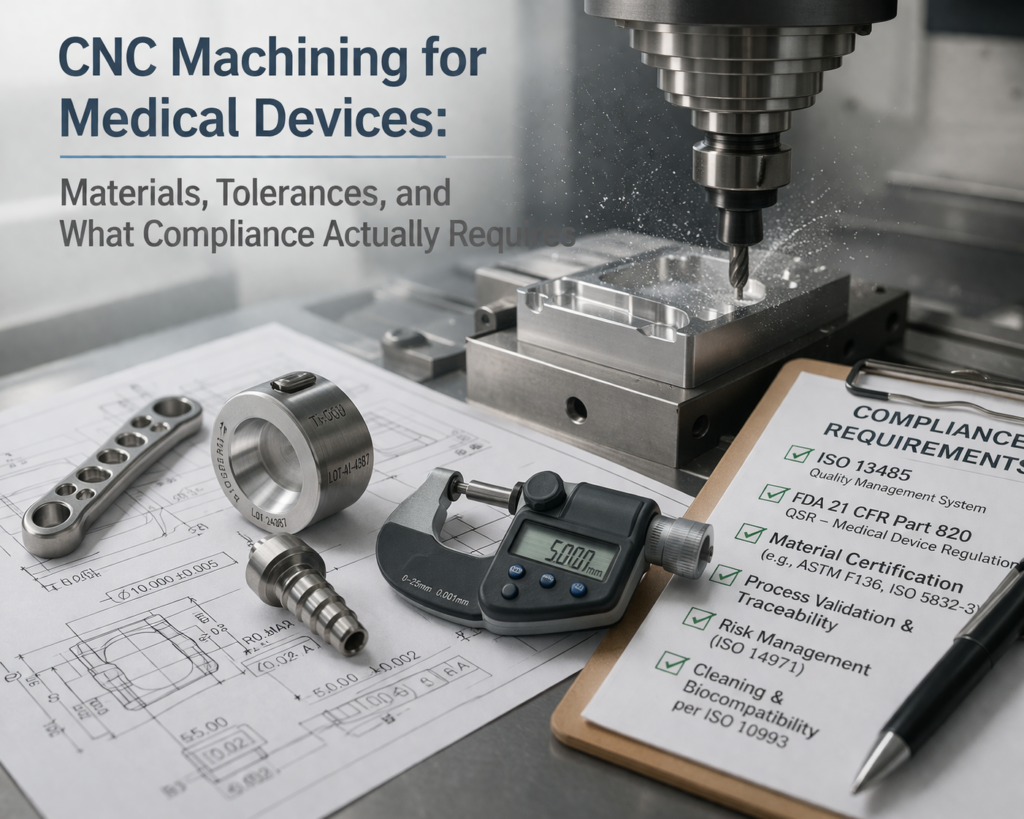
CNC machining for medical devices operates under a fundamentally different set of requirements than general industrial machining. It’s not just about tighter tolerances — though those matter. It’s about material traceability, biocompatibility, sterilization compatibility, surface finish control, and the documentation discipline required by regulatory frameworks like ISO 13485 and FDA 21 CFR Part 820.
This article covers what medical CNC machining actually involves, what materials are used and why, what tolerances are realistic, and what to look for in a supplier.
Medical Device Categories and Their CNC Requirements
Surgical Instruments
Forceps, retractors, clamps, and cutting instruments are typically machined from 303 or 17-4PH stainless steel. These materials offer the combination of hardness, corrosion resistance, and polishability required for instruments that must survive repeated autoclave sterilization cycles without degradation. Surface finish is critical — Ra 0.4μm or better on contact surfaces, with no crevices or surface defects that could harbor contamination.
Orthopedic Implants and Implantable Components
Implantable components operate inside the human body — which means biocompatibility is non-negotiable. Titanium Grade 5 (Ti-6Al-4V ELI, per ASTM F136) is the standard material for load-bearing orthopedic implants: hip stems, knee components, spinal cages, and bone screws. The ELI (Extra Low Interstitial) grade specifies tighter limits on oxygen, nitrogen, and hydrogen than standard Ti-6Al-4V, optimizing fatigue strength and ductility for implant applications.
PEEK is increasingly used for spinal implants — interbody cages and vertebral spacers — because its modulus of elasticity is closer to bone than metal, reducing stress shielding. It’s also radiolucent, which allows post-operative imaging without artifact interference.
Medical Equipment Components
The broader category of medical equipment — imaging systems, diagnostic instruments, infusion pumps, ventilators, robotic surgery systems — uses a wide range of CNC machined components. Housings and structural components are often 6061 aluminum with anodized finish. Fluid pathway components are 316L stainless or PEEK. Precision positioning components require tight tolerances on bearing fits and alignment features. Electronics brackets and enclosures need controlled flatness for gasket sealing.
Materials: What's Used and Why
- Titanium Grade 5 (Ti-6Al-4V / Ti-6Al-4V ELI) — implantable components, surgical instruments requiring maximum strength-to-weight ratio
- 316L Stainless Steel — surgical instruments, fluid-handling components, anything requiring autoclave compatibility and corrosion resistance
- 17-4PH Stainless — high-strength surgical tools and structural medical components
- PEEK — spinal implants, endoscopic components, any application requiring radiolucency and chemical resistance
- 6061 Aluminum (anodized) — medical equipment housings, brackets, non-contact structural components
- Delrin (POM) — low-friction mechanical components in equipment; not suitable for implantable use
Tolerances in Medical CNC Machining
Medical device tolerances are among the tightest in any industry. For orthopedic implants, dimensional tolerances of ±0.010mm to ±0.025mm are standard on functional features. Bore diameters for press fits may require ±0.005mm or tighter. Surface finish requirements of Ra 0.2–0.8μm are common on contact and sealing surfaces.
These tolerances require CMM inspection as standard — not sampling, but 100% inspection on critical dimensions for implantable components. Every part ships with a dimensional report documenting actual measured values.
Documentation and Traceability Requirements
Medical device manufacturing operates under quality management systems — ISO 13485 for medical devices globally, FDA 21 CFR Part 820 for the US market. These frameworks require that every component in a medical device can be traced back through the supply chain: who made it, when, from what material, to what drawing revision, and with what inspection results.
For CNC machined medical parts, this means material certifications with full traceability to mill heat and lot numbers, dimensional inspection reports for every order, first article inspection for new parts or revised drawings, records retained for the duration required by the applicable regulation (typically the device lifetime plus additional years), and a supplier who operates their own documented quality management system.
Suppliers who treat documentation as an afterthought are a regulatory liability in a medical supply chain. The documentation requirements aren’t bureaucratic overhead — they exist because traceability in a field safety event can be the difference between a targeted recall and a broad one.
What to Look for in a Medical CNC Supplier
- Experience with medical-grade materials — especially titanium ELI and implant-grade PEEK, which require process expertise beyond standard machining
- CMM inspection capability and documented measurement systems — not just measuring equipment, but calibrated, traceable, documented
- Material certification practice — mill certs provided as standard, with clear lot traceability
- Clean machining environment — medical parts shouldn’t be produced alongside heavily contaminating processes without controlled separation
- Engineering engagement — a supplier who reviews drawings and flags issues before cutting, not after
→ Working on a medical device component? Tell us about your application and we’ll advise on materials, tolerances, and documentation requirements.